When I wrote about the Cardinal Virtues of Fencing a few weeks, I shared that I was excited to pursue them and what they meant to my fencing. I knew going in that things would get a little fuzzy and it would take some time before I gained a solid foothold in how they worked. If you haven’t read that post yet, I’d encourage you to do so before continuing here, because this is the first thing I’m running up against as I talk and implement the virtues in my own fencing and my teaching.
A Quick Recap (And Where Things Got Fuzzy)
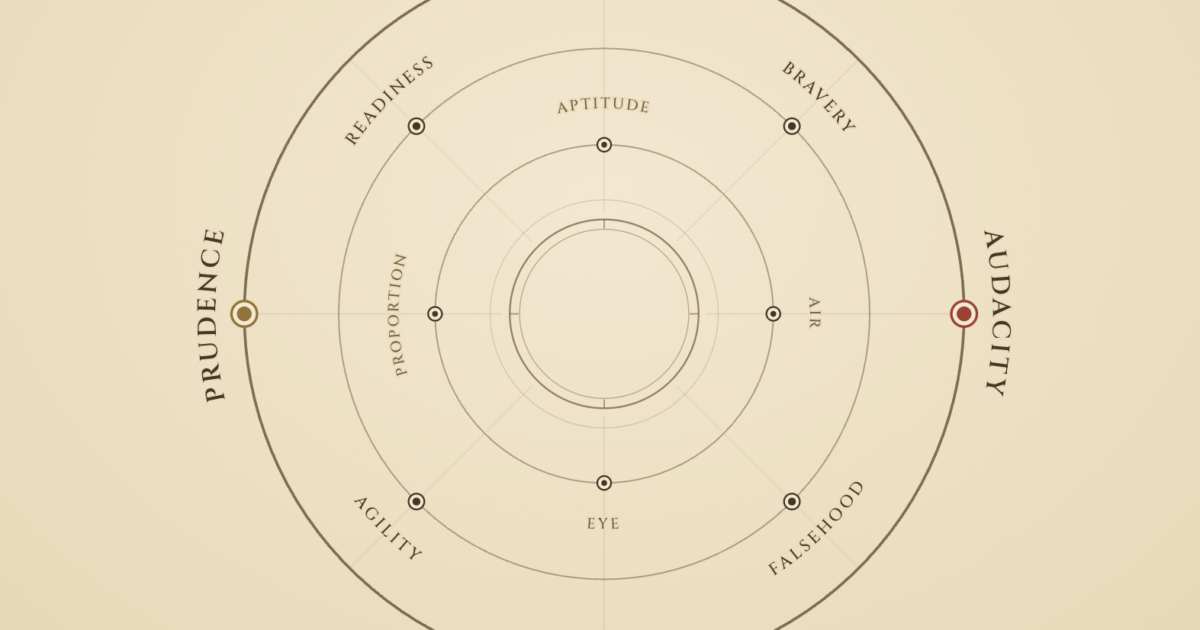
To refresh: the framework lays out four base Virtues — Fortitude, Audacity, Celerity, and Prudence. These are the things you train. The things you develop. The things you deliberately work on every time you pick up a sword.
Then there are the Qualities — Bravery, Eye, Agility, and Proportion to name a few (there are eight in total). These emerge when the virtues combine in different ways. Bravery from Fortitude and Audacity. Eye from Audacity and Prudence and Celerity. Agility from Celerity and Prudence. Proportion from Fortitude and Prudence and Celerity. When you combine all four virtues, you end up with Mastery.
As I had conversations with folks, here’s where we started getting a little turned around, and honestly, I include myself in that. The qualities sound like goals. They have names. They feel like achievements you could tick off a list. And so the natural question becomes: “How do I get Agility? How do I train for Bravery?”
That’s the wrong question, though. And I don’t mean that harshly — it’s the obvious question. As I’ve pondered on these conversations and questions, I’ve realized that this line of thinking just leads you somewhere you don’t want to go.
The Qualities Aren’t the Target
In Wiest’s original articles, he purpose was to describe mastery and what could be gained by understanding what a master fencer looked like. Think about it. What does a master fencer looks like? Not a good fencer, not a skilled fencer — a master. If you were going to describe them, you’d reach for words like the qualities. They have an eye for what’s happening. There’s a bravery in how they engage. Their movement is agile. Everything they do has a sense of proportion — nothing wasted, nothing excessive, a kind of elegant balance to it all.
Those are descriptions. They’re what you’re observing when you watch mastery in action.
But here’s the thing: that master didn’t get there by training “Eye.” They got there by developing their Prudence — their wisdom, their ability to read a situation, to wait, to see what was actually happening rather than what they feared or hoped was happening. They got there by developing their Audacity — their willingness to act on what they saw, to commit, to not flinch at the moment of decision. The Eye emerged from that. The Eye is what it looks like from the outside.
So the qualities are descriptive language. They’re how we talk about fencing we admire. The virtues are prescriptive language. They’re what you actually go do.
What This Means in Practice
This distinction changes how you should be thinking fencing, even down to individual techniques — any technique, at any skill level.
When you’re working on something new, or trying to improve something you’ve already got, the question isn’t “does this have Agility in it?” The question is: What does Fortitude look like here? What does Celerity ask of me? Where’s the Prudence? Where’s the Audacity?
Those are the questions you can actually do something with, even though they’re kind of difficult to answer.
I was working with my apprentice Yip last practice, developing a block/attack combo in conjunction with a rush, and we landed on that this particular technique is going to require a certain level of Agility. As you’d expect, the follow up question was How. How to develop that Agility? It’s a fair question — Agility is one of those words that feels intuitive, like you should be able to just… reach for it. But we had to slow a little.
Agility, in this framework, comes from Celerity and Prudence working together. So what does that actually mean for the technique? It means we have to build her Celerity — the swiftness, yes, but also the trained ease. The nonchalance that comes from repetition until the motion stops being effortful. And we have to build her Prudence — the wisdom to read the situation, to time the action correctly, to not just be fast but be fast at the right moment. Along with how guide the fight towards the trigger that would kick the whole sequence off. When those two things are genuinely developed in her, the Agility will be there. We won’t need to name it. You’ll just see it.
That’s the pattern. Work the virtues. The qualities show up on their own. I saw it as we drilled the technique. We were practicing the sequence in a very controlled way, but when Yip timed the action correctly (Prudence), moved swiftly and easily (Celerity), Agility showed up.
Ask the Hard Questions and BReak It Down
I recognize that this pattern is not easy. Looking at your fencing through the lens of the virtues — whether it’s your overall development or a single technique — requires you to sit with questions that can feel vague or uncomfortable at first. What does Fortitude look like here? That’s not always an obvious answer.
But that’s actually what I’ve come to appreciate most about this framework. Any technique I’m working on, anything I’m struggling with — I’ve got four directions I can look. Four questions I can ask. And one of them is going to point me somewhere useful.
Don’t be afraid to ask the hard questions. Learn to recognize the virtues in what you’re doing, and watch for the qualities to show up on their own — in your fencing, in your opponents’, in the fencers you admire. They will show up. You just have to do the work first.
So next time you pick up your sword and start drilling something, try asking yourself: What does Fortitude look like here? Start there. See what comes up.
That’s the pattern.