By my very nature, I like to collect and look out for frameworks. That’s just how I work. If you have a big messy subject and organize it in a way with pillars, categories, connections, and names that pull everything together in an interesting way, I’m in. I like models that optimize the structure of information. The really good ones lay a strong foundation for more questions and constantly invite further exploration.
Early on, I found this as I studied the Scola Metallorum. My young fencing mind was drawn to the 4 Types of Fighters, and for years I delved into what that meant, what could be learned, and how Chargers, Blockers, Runners, and Shifters added depth and understanding to my fencing experience. Later on when I started taking on apprentices, I extracted additional principles from that same manual to build out my own pillars of fencing. Footwork. Proficiency. Body Mechanics. Attack Their Weapons. Mentality. Those were distilled into more principles and more depth which I used to teach my students.
Both of these examples came from seeds of study. Some thing I came across while researching and pondering about fencing in general that caught my interested. They resonated with me and inspired years of additional study and knowledge gained.
And I believe I’ve stumbled across the next one.
The Short Version
I recently came across a blog that had written two posts about the virtues of fencing. They’re great reads, although Wiest (the author) goes into a lot more historical depth than I normally care for, but still fascinating.
The first was called The Virtues of Fencing and it was a deep dive into particular qualities and attributes (virtues) that historical masters and scholars considered crucial to building the ideal form. While each master he referenced had slightly different interpretations he landed on the virtues of Prudence, Celerity, Fortitude, and Audacity, as declared by Fiore dei Liberi as the ones of focus.
The second article, The Great Masters, took the concept of virtues a step further and Wiest walked through his interpretation of how each virtue and their subsequent combinations build a path to mastery.
Can you see why something like this would draw my attention?
As I read these articles, the seeds of this framework and the application of both technique and ethereal concepts resonated with me. I’ve been thinking about them for weeks now and I want to share these concepts because I hope they resonate with you too.
The four Cardinal Virtues
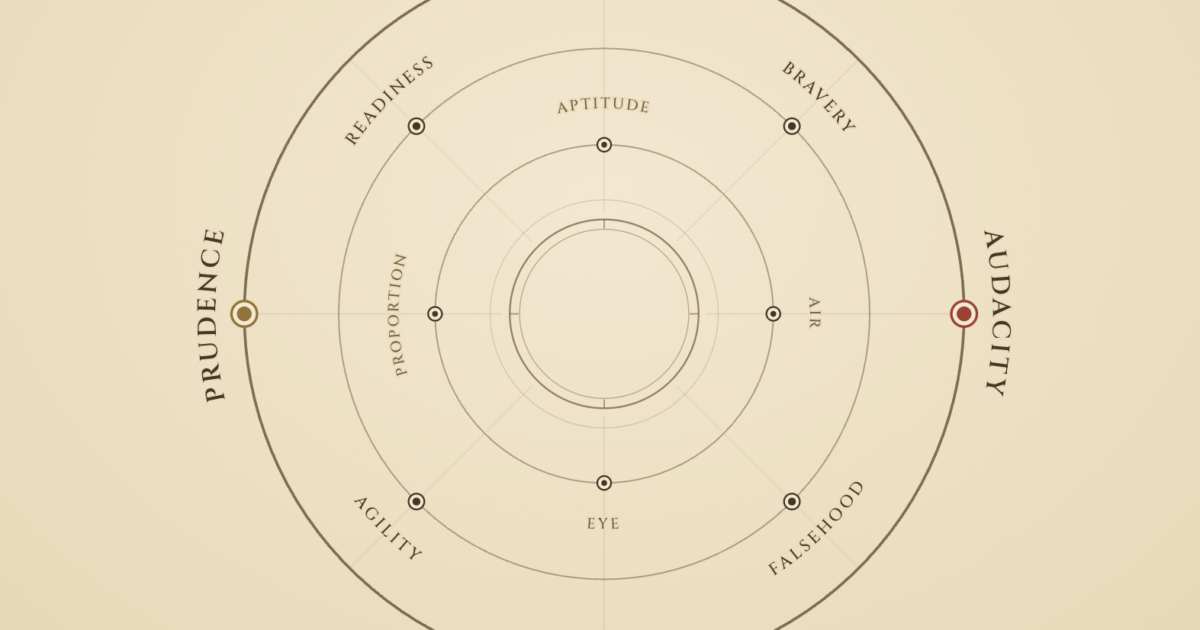
The four big virtues to keep in mind are Fortitude, Audacity, Celerity, and Prudence. I’ve been thinking about them as if they were the four cardinal directions of the compass. They have aspects of both technical skill and inner qualities to how we fence. In Wiest’s articles, there was an implied order to these, but I’ve been thinking of them more as areas that every fencer must address at some point.
Fortitude
Fortitude here doesn’t just mean your strength or your foundation. It’s describing your ability to endure and to hold (this is not the Hold! command), meaning to stand your ground. Can you fight without flinching? Can you stay composed when what you need to do is wait? Can you hang on through difficult times, loss, and the uncomfortableness of training even when it doesn’t immediately translate to winning? Fortitude has a physical side and mental side, both feeding into each other. There is structure to be gained so you’re fencing with your whole body and not falling apart under pressure. That structure feeds into your composure and the trust you have in your own defense and abilities.
Audacity
If you’re like me, audacity normally feels like a bad thing. Something to avoid. But as a virtue, this is your will to act. To commit and actually turn an idea or a moment into actual progress. The audacity to face another person carrying a sword and go for it! You have to have some amount of audacity and boldness to do well in fencing. Too little and you’re timid. Too much and you’re reckless. Finding the balance and the proper application is where the virtue of Audacity comes into play. Physically being able to strike well and with purpose. Blocking with confidence and immediately returning with a riposte. Mentally facing other fencers. Bigger fencers. Scarier fencers. Less experienced fencers. It doesn’t matter. As a fencer, you have to be audacious.
Celerity
Now, I have to admit, before reading this article I had never heard the word “Celerity”. I had to look it up and it’s essentially a formal word for swiftness. But not just in the sense of speed, but also the quickness of action and a studied nonchalance to our technique. As a virtue, this is understanding that speed and skill come through repetition, working until it stops looking like effort. If we’re moving fast but have no form, than we’re just flailing. Mastery of celerity is an unglamorous truth. To truly develop speed and skill, you have to work and drill until your form supports an effortless fluency in our craft.
Prudence
Prudence is your ability to apply what you know. Practical wisdom. It’s not just having the knowledge, it’s understanding what you’re doing and why, and knowing when to use it. A sense of cunning. A fencer applying prudence recognizes when their block is too big and tightens it up. They see a pattern in how someone fights and figure out how to exploit it. They know to wait an extra beat for the opening that comes after the first attack, instead of forcing one that isn’t there. Fencers who have developed a lot of prudence can read the fight as it’s happening and foresee what’s likely to come next. They can also study and understand a fight away from the field, breaking down what worked and what didn’t, informing their plan. This is the virtue that builds our awareness of the fight, and like the others, it takes time and a lot of bouts to earn.
The Eight Compound Virtues
So those are the four big ones, but in the second article, Wiest delved deeper into how these cardinal virtues combined into additional virtues. Virtues that only start showing up when you develop these first ones. I love that!
It’s aspirational to focus in on these four virtues, and work to combine them. At first, you get a new set of four by combining two cardinal virtues. Then as you develop, you combine three and get an additional set of four. Finally, when you are combining all four virtues at once, what you have is mastery. Mastery that is founded on the core principles of what make a good fencer, in both technical skill and internal quality.
Bravery = Fortitude + Audacity
Standing firm and acting boldly. You describe brave fencers as those who can take on the challenge and face it with confidence.
Falsehood = Audacity + Celerity
The deception and lies that we tell in our fencing. Baiting to our opponent to do one thing and quickly capitalizing on their mistake. We have to be audacious to try and slip something past our opponent but also swift enough to make them pay for it.
Agility = Celerity + Prudence
We’re agile with purpose. A great fencer doesn’t just run around and wave their arms. We move when we need to and act when the opportunity presents itself. There is trained intentionality.
Readiness = Prudence + Fortitude
Being ready is a calm alertness. You’re grounded and watching at the same time. You’re not tense, not passive, just prepared for whatever comes.
Air = Fortitude + Audacity + Celerity
It’s looking dangerous before you’ve done anything. The presence that makes an opponent hesitate. Confidence you can see in how someone just stands and carries themselves.
Eye = Audacity + Celerity + Prudence
The fast perception that fires mid-fight. Seeing the opening and already moving toward it. Being able to watch and catch the details flying past you in a split second, letting that guide your next move or holding on to it for later.
Proportion = Celerity + Prudence + Fortitude
Proportion isn’t about your physical proportions, it’s about the balance found in the fight. Correct distance, timing, and amount of everything applied. Nothing is wasted or forced. Nothing overdone or under utilized. A proportional fencer has a clean fight because everything felt right.
Aptitude = Prudence + Fortitude + Audacity
The knack for doing the right thing under pressure. Reading the moment, holding your nerve, and committing, all at once. Even if it’s difficult, you find a way to pull it off.
A Path to Pursue
With the 4 Types of Fencers and the Five Pillars, they were frameworks that I built based on the seed of an idea. I took something and refined it. Made it my own. As I read these articles, my first instinct was to do the same thing. Redefine, rename, and make new connections to turn it into something different. Build a cleaner version they way I wanted.
But as I’ve been thinking about it. Chewing on these ideas. Honestly, I think I’m good.
I went to fencing last week and focused solely on Fortitude and I can see it. I can see the value in pursuing this model. I can see how they build into one another and how just focusing on the virtues themselves will lead to so much thought and discussion, there isn’t a need to reinvent the wheel with my own convoluted shape.
I have been fencing for almost 20 years now, and I’m ready to pursue something again, rather than build. Holding myself to these virtues and what they mean, both on and off the field, feels like the next big step for me and my fencing journey.